
How Virtual Reality (VR) Is Transforming Upskilling and Workplace Training
Virtual Reality is no longer limited to gaming or experimental use cases. It is now a proven, practical learning tool being used across industries to support skills development, safety training, onboarding, and leadership development. By placing learners inside realistic, immersive environments, VR is transforming how people learn, practise skills, and build confidence at work.

Why Virtual Reality Matters for Upskilling
Think about how athletes, performers, and professionals prepare for high-pressure moments. Long before they step onto the field, the stage, or into a critical situation, they mentally rehearse. They imagine the environment, visualise their actions, anticipate challenges, and practise responses in their mind.
Psychology tells us this kind of visualisation and mental practice strengthens neural pathways, improves recall, and builds confidence — even before physical performance begins.
Virtual Reality takes this powerful concept and brings it to life.
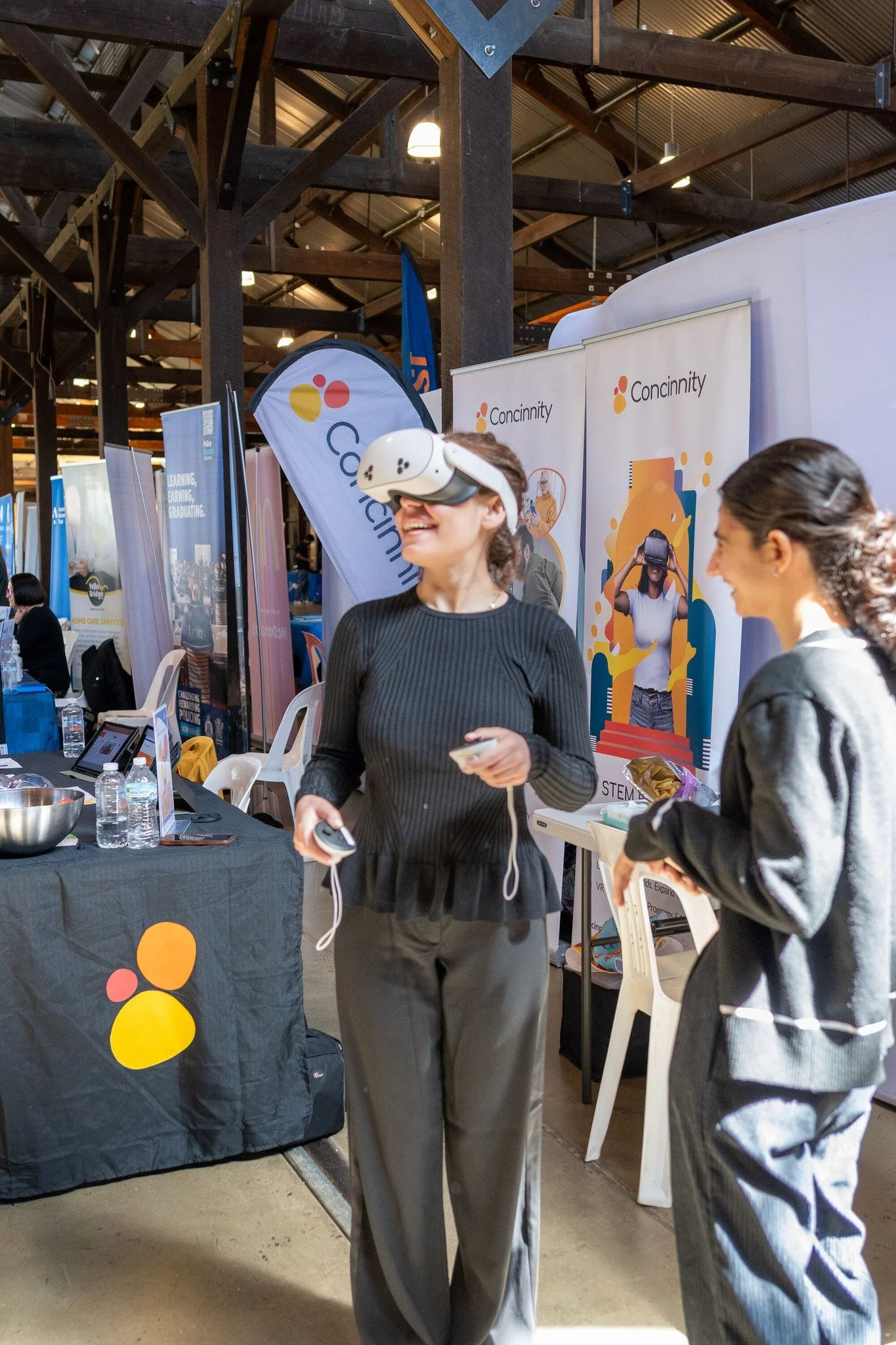
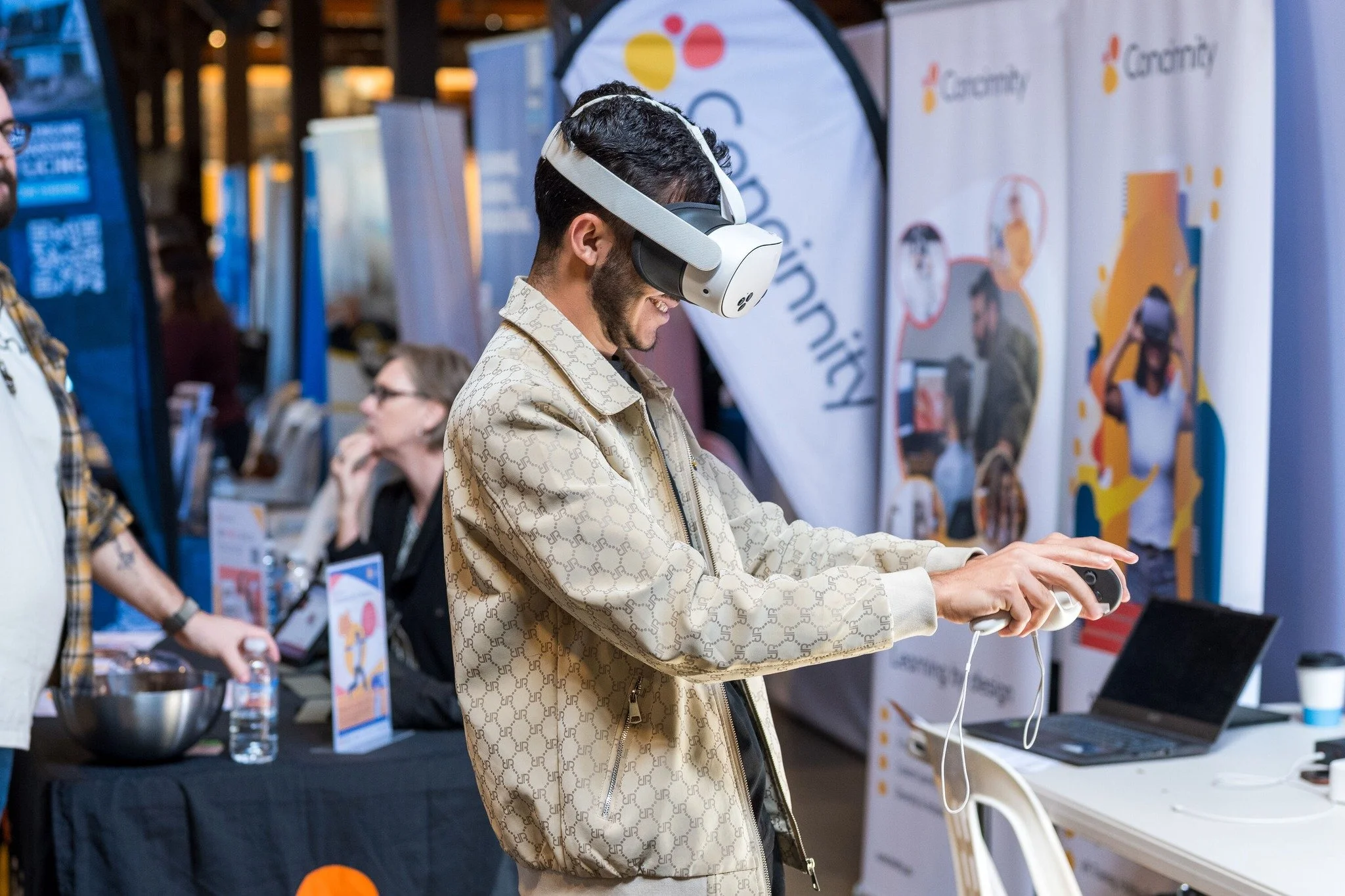
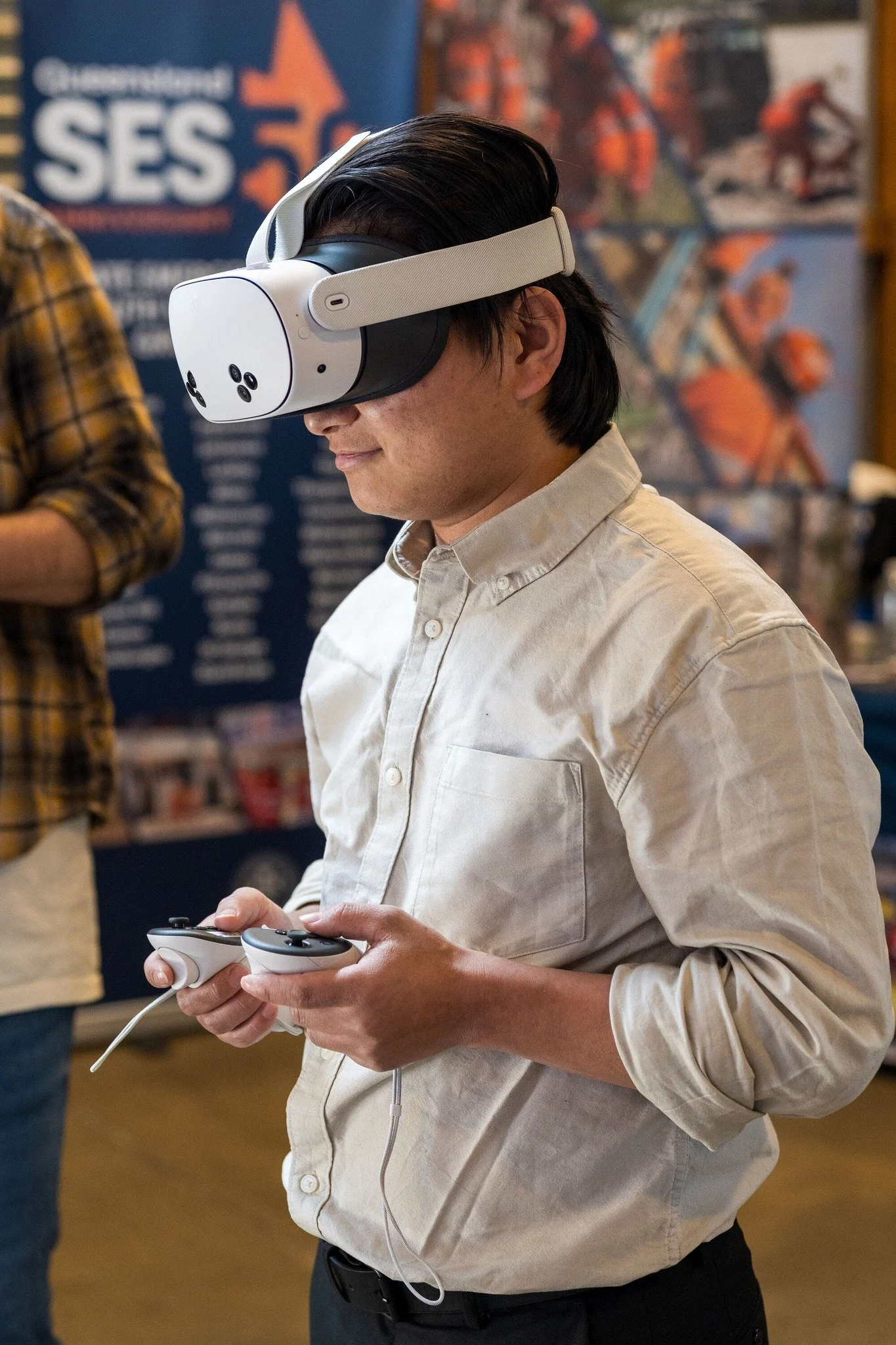
With VR training, learners don’t just imagine the situation — they step inside it. You’re immersed in a realistic environment, able to look around, look down at your hands, move, respond, and make decisions. Your brain processes the experience in ways that feel remarkably close to real life.
Instead of watching someone else do the task, you are doing it. Instead of hoping you’ll remember what to do, you’ve already practised it.
This taps into experiential learning, embodied cognition, and muscle memory, allowing people to learn through experience rather than instruction alone. Learners can practise safely, make mistakes without real-world consequences, and repeat scenarios until confidence builds naturally.
By the time they step into the real workplace, the situation feels familiar — not new, not intimidating.
That’s why VR is so effective for upskilling: it combines the proven benefits of visualisation and practice with immersive technology, helping people build confidence before performance and apply skills more effectively when it truly matters.
Real-World Examples of VR Being Used to Upskill
Sydney Trains — Emergency Response and Safety Training
Sydney Trains has implemented a VR training program for over 3,000 train drivers and guards to strengthen emergency response capability. Immersive simulations expose trainees to realistic crisis scenarios they may face on the rail network, improving preparedness, confidence, and consistency of safety practices across the workforce.Source: Digital NSW – Transport for NSW - VR training to deliver safer reality
“This demonstrates how VR can be embedded into ongoing professional development and scaled across a large workforce where real-world practice is logistically difficult or high risk.”
Industry-Wide Safety and Technical Skills
Across healthcare, mining, manufacturing, defence, and engineering sectors, VR is being used to upskill workers in hazard awareness, equipment operation, maintenance procedures, emergency response, and remote site familiarisation. Immersive simulations allow teams to practise complex or dangerous tasks with no real-world consequences.
Source: Sentient Computing - VR training
“VR removes barriers to high-risk training, enabling repeatable, measurable practice that translates directly to safety and operational performance.”
Corporate and Soft Skills Training
Many organisations are using VR to develop soft skills such as leadership, inclusive behaviours, customer service, and communication. Learners practise realistic interpersonal interactions in VR and receive feedback, building confidence and competence more effectively than traditional classroom or eLearning approaches.
Source: PwC Australia - Upskilling training VR metaverse
“Soft skills are increasingly critical in modern work, and VR enables experiential learning that traditional training methods struggle to replicate.”
Cybersecurity and Technical Upskilling in Virtual Labs
Australian education and training providers are using VR to simulate cybersecurity environments where learners practise identifying threats and responding to incidents in virtual networks. This provides hands-on experience without exposing real systems to risk.
Source: eSkilled LMS
“VR enables high-stakes technical training in a controlled setting, preparing learners for real-world digital and cyber challenges.”
Medical and Emergency Skills Training
Healthcare and training organisations are increasingly integrating VR into CPR, first aid, and clinical skills training. Learners can practise life-saving procedures in realistic emergency simulations, building muscle memory and confidence without risk to patients.
Source: eSkilled LMS - Benefits of VR training
“VR supports practical skill development and confidence-building in high-pressure situations where real-world practice opportunities may be limited.”

Key Benefits of Virtual Reality (VR) for Workplace Training and Upskilling
1. Faster Learning and Stronger Skill Development
Australian research shows that VR can significantly accelerate learning. PwC Australia reports that employees trained using VR can learn up to four times faster than those trained through traditional classroom methods. By placing learners directly inside realistic scenarios, VR reduces distraction and improves focus.
Importantly, this applies not only to technical skills, but also to leadership, communication, resilience, and inclusive behaviours, where experiential learning improves understanding and transfer into real work settings.
2. Increased Confidence Through Immersive Learning
Confidence is a critical driver of workplace performance. PwC research found that learners trained using VR felt up to 275% more confident applying their skills at work compared to classroom-trained learners.
This confidence comes from repeated exposure to realistic situations, allowing learners to practise responses, refine behaviours, and feel prepared before facing real-world challenges — particularly valuable for onboarding, safety training, and role transitions.
3. Safe and Scalable Training Environments
Virtual Reality provides a safe environment to practise tasks that may be dangerous, costly, or impractical to replicate in real life. In Australia, VR is increasingly used for:
Safety and hazard awareness training
Emergency response simulations
Technical and mechanical skill development
High-risk industry training
Because VR training is digital and repeatable, organisations can deliver consistent learning experiences across multiple sites and locations.
4. People enjoy it!
One of the most overlooked benefits of VR training is that people actually enjoy it. VR feels different from traditional training. It breaks routine, sparks curiosity, and invites learners to actively participate rather than passively sit through content. That novelty matters — when learning feels engaging and slightly unexpected, people are far more likely to remember it.
Because VR is immersive and experiential:
Learning becomes more memorable
Concepts stick longer
People recall what they did, not just what they were told
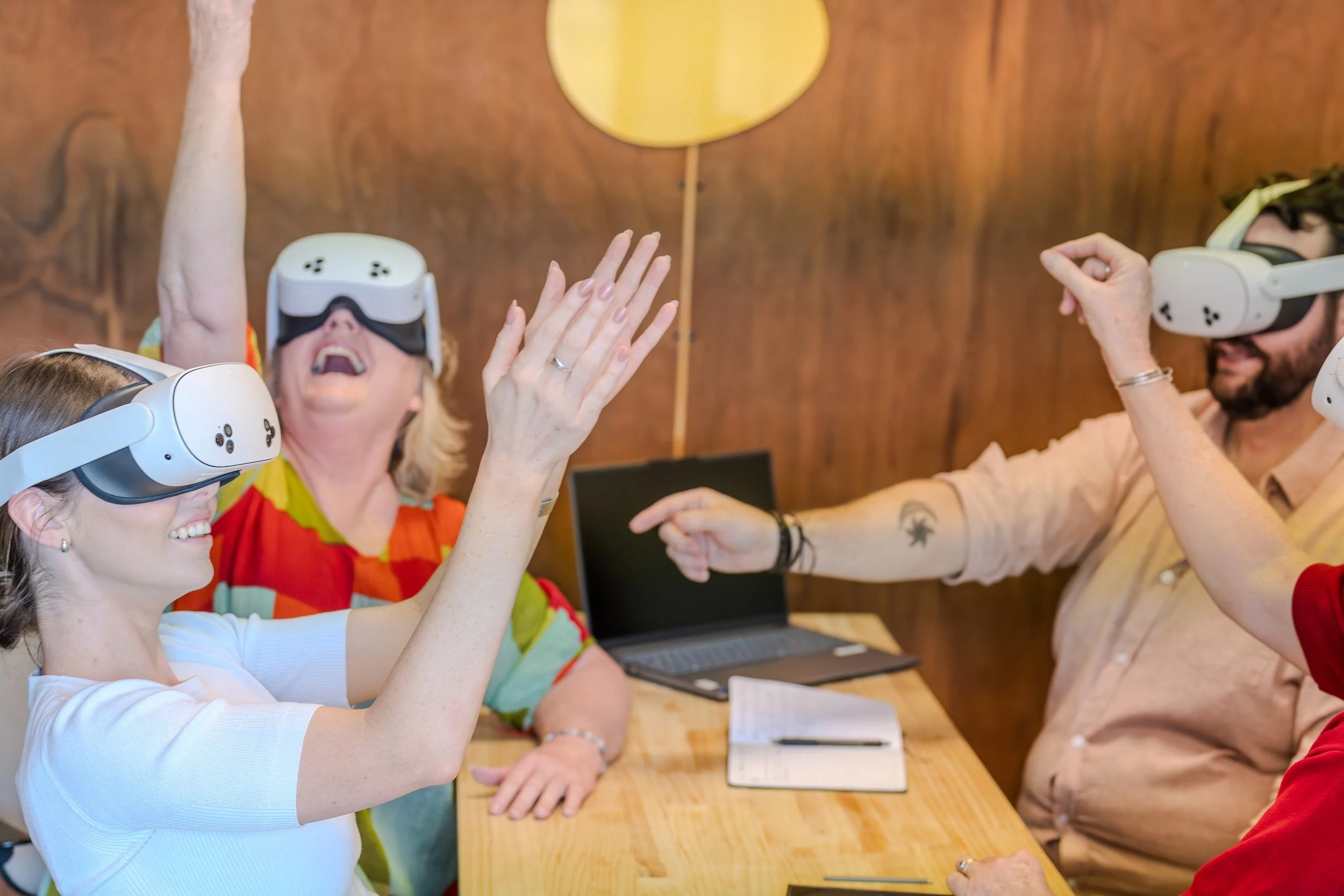
For new teams, VR can also act as a powerful icebreaker. Shared immersive experiences create conversation, reduce awkwardness, and help people connect — especially in onboarding or group training settings. Instead of starting with slides and policies, teams start with a common experience they can reflect on together.
Most importantly, when learning is enjoyable, people are more open, more engaged, and more willing to practise and try again.
That combination — engaging, memorable, and practical — is what makes VR such a powerful tool for modern learning and upskilling.
How Concinnity Uses Virtual Reality to Design Meaningful Learning
At Concinnity, we see Virtual Reality as a strategic learning tool — not innovation for its own sake.
VR is a practical way to improve learning outcomes. We use Virtual Reality to help organisations build capability faster, safer, and with greater confidence.
VR allows people to practise real tasks, make decisions, and learn from experience — before they’re on the job. The result is shorter learning time, improved readiness, and reduced risk, across technical, safety, and leadership training.
We help organisations:
Identify where VR will deliver the most impact
Design practical, job-relevant VR learning experiences
Integrate VR into onboarding, eLearning, and blended training programs
Pilot, refine, and scale immersive learning across teams and locations
If you’re looking for training solutions that deliver measurable performance outcomes, VR is a powerful tool — and we can help you use it effectively.
👉 Talk to us about how VR could strengthen your training and upskilling strategy.
References
PwC Australia (2024). Upskilling and training in the VR-enabled metaverse. Digital Pulse.
https://www.pwc.com.au/digitalpulse/upskilling-training-vr-metaverse.htmlPwC Australia (2023). The future of work and immersive learning technologies.
https://www.pwc.com.au/insights/future-of-work.htmlUNSW Business Think (2023–2025). How virtual reality is transforming education and business learning.
https://www.businessthink.unsw.edu.auNational Centre for Vocational Education Research (NCVER) (2022–2024). Digital and immersive learning in VET. https://www.ncver.edu.au
CSIRO (2021–2023). Immersive technologies and the future workforce.
https://www.csiro.auDeloitte Australia (2023). The future of learning and immersive workforce development. https://www.deloitte.com/au
Australian Government – Department of Education (2023). Emerging technologies in skills and workforce development. https://www.education.gov.au